
How to reconstitute peptides
Here you'll find how to put water into the vial with your dry medicine, how much to add and how to mix it gently.
Reconstituting a peptide means mixing it with water. The medicine arrives as a dry powder inside a small glass bottle, which is called a vial. After you add water, you can draw a dose into a syringe. Freezing is how the powder is dried, so it often ends up as a small cake at the bottom of the vial. Then our peptide reconstitution calculator tells you how far to fill the syringe.
What you need before you start
Before any caps come off, lay out a sharps container, alcohol pads, a syringe, the powder vial and a bottle of bacteriostatic water. Sterile water with a small amount of benzyl alcohol (0.9%) in it is bacteriostatic water. That benzyl alcohol keeps germs from growing, so you can reuse the same bottle. Used needles go in a sharps container, which is a hard plastic box.
Clear a clean counter and place 2 fresh alcohol pads next to the vial before you begin.
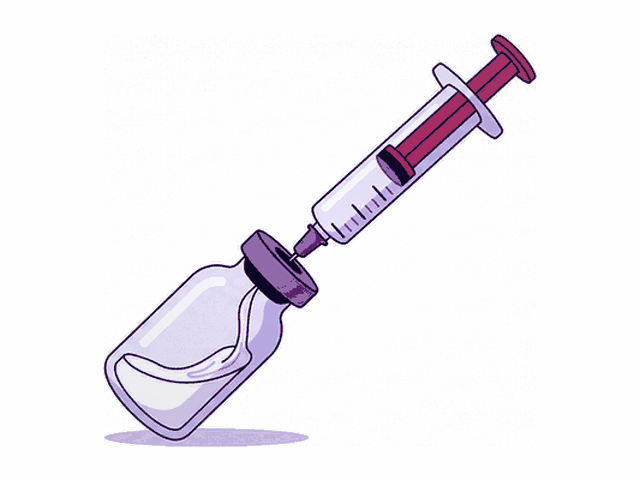
Mixing steps for how to reconstitute peptides
- Wash your hands with soap and water and dry them on a clean towel.
- Remove the plastic caps from both bottles. Use an alcohol pad to wipe each rubber top, then let it dry.
- Draw air into the syringe, matching the amount of water you'll add. Push the air into the water bottle and then draw the water into the syringe.
- Push the needle in at a slight angle, into the center of the peptide vial's rubber top. Push the plunger down slowly; the water then runs along the inside of the glass.
- Draw the needle straight out, then the syringe goes into your sharps container without delay.
- Roll the vial gently for 30 seconds between your hands, until the powder is gone. Don't shake the vial.
- Look at the liquid and make sure it's clear. Put the date on the label, then store the mix following the instructions from your drug label or seller. Our peptide storage page has more on this.
The Egrifta SV label is one official drug label, and its directions match our mixing steps. This peptide medicine, Egrifta SV, comes as a powder you mix yourself. Follow those steps instead if your label or your doctor tells you something different. If you have tirzepatide, our guide to reconstituting tirzepatide is here too.
How much water should you add?
No matter how much water you add, the amount of medicine in the vial stays the same. Adding more water just spreads the same medicine through a larger amount of liquid. Then each dose takes up more of the syringe, so you can read the lines more easily.
Consider this example. Take an example: a vial with 5 mg of medicine, and a dose of 250 mcg (1 mg equals 1,000 mcg). The tiny marks on an insulin syringe give you units. On the common kind, called U-100, 100 units equal 1 mL. With 1 mL of water added, the syringe fills to the 5-unit line. With 2 mL instead, the syringe goes to the 10-unit line. Either way, the dose is the same.
These numbers only show how this works. They aren't a dose to take; the amount you use is set by your doctor, nurse or drug label. Our peptide reconstitution calculator works out the numbers for your own vial and water.
Peptide mixing and reconstitution chart
Look up your vial size and the amount of water you added. The row gives the strength of the mix and the unit count for filling two sample doses.
| Vial | Water | Strength | Units for 100 mcg | Units for 1 mg |
|---|---|---|---|---|
| 2 mg | 1 mL | 2 mg/mL | 5 units | 50 units |
| 2 mg | 2 mL | 1 mg/mL | 10 units | 100 units |
| 2 mg | 3 mL | 0.67 mg/mL | 15 units | 150 units over 1 mL |
| 5 mg | 1 mL | 5 mg/mL | 2 units | 20 units |
| 5 mg | 2 mL | 2.5 mg/mL | 4 units | 40 units |
| 5 mg | 3 mL | 1.67 mg/mL | 6 units | 60 units |
| 10 mg | 1 mL | 10 mg/mL | 1 unit | 10 units |
| 10 mg | 2 mL | 5 mg/mL | 2 units | 20 units |
| 10 mg | 3 mL | 3.33 mg/mL | 3 units | 30 units |
| 15 mg | 1 mL | 15 mg/mL | under 1 unit | 6.7 units |
| 15 mg | 2 mL | 7.5 mg/mL | 1.3 units | 13.3 units |
| 15 mg | 3 mL | 5 mg/mL | 2 units | 20 units |
| 20 mg | 1 mL | 20 mg/mL | under 1 unit | 5 units |
| 20 mg | 2 mL | 10 mg/mL | 1 unit | 10 units |
| 20 mg | 3 mL | 6.67 mg/mL | 1.5 units | 15 units |
| 30 mg | 1 mL | 30 mg/mL | under 1 unit | 3.3 units |
| 30 mg | 2 mL | 15 mg/mL | under 1 unit | 6.7 units |
| 30 mg | 3 mL | 10 mg/mL | 1 unit | 10 units |
Swirl, don't shake
Peptide powders mix best when handled gently. With the needle aimed at the inside of the glass, water runs down onto the powder rather than splashing or foaming.
According to the Egrifta SV label, roll the vial gently in your hands for 30 seconds; shaking it is not allowed. If a few tiny flakes remain, leave the vial standing for a couple of minutes and roll it again until you see a clear liquid.
Mistakes people often make when mixing peptides
- Units vs mL: 0.1 mL in a U-100 syringe means 10 units, not 1 unit.
- Confusing mg with mcg: 250 mcg equals 0.25 mg. Swap them by mistake and the dose becomes 1,000 times larger or smaller, so check which one your label uses.
- Using more water than planned and sticking with the old unit count weakens each unit, so a dose of the same size takes more units. Use the calculator once more.
- Some syringes show 40 units in 1 mL rather than 100, so you can grab a U-40 syringe by mistake. Before you fill the syringe, check the scale that is printed on it.
Questions people often ask
Must you use bacteriostatic water?
When you use a vial more than once, it is mixed with bacteriostatic water; the benzyl alcohol in it stops germs from growing between doses. Nothing is added to plain sterile water, so any mix made with it has to be used right away; throw away the rest. Your pharmacist or your drug label can tell you which water this vial needs.
Why does my peptide look cloudy?
The Egrifta SV label tells you to roll a mixed vial gently, and to keep going until the liquid is clear. Don't inject it if it stays cloudy or if there are bits floating in it. Ask your pharmacist, your doctor or your nurse what to do.
How long is a mixed vial good for?
The CDC tells you to date an opened bottle of bacteriostatic water, then throw it away within 28 days. After a drug is mixed, the label on that drug says how long the mix lasts. The Novarel label, for an hCG medicine, directs you to store the mixed vial in the refrigerator and use it within 30 days.
Other related pages
- Reconstitute tirzepatide
- Reconstitute semaglutide
- Reconstitute retatrutide
- Reconstitute BPC-157
- Reconstitute CJC-1295 and ipamorelin
- Reconstitute MOTS-c
- Reconstitute NAD+
- Reconstitute GLOW peptide
- Reconstitute KLOW peptide
- Reconstitute HGH
- Reconstitute hCG
- Reconstitute tesamorelin
- Reconstitute PT-141
- Reconstitute sermorelin
- Peptide reconstitution calculator