
Best syringe for peptides
For simpler drawing and clearer readings of small peptide doses, pick a U-100 insulin syringe that has clear unit marks plus a short, thin needle.
- Syringe size: 0.3 mL
- 30 units
- Syringe size: 0.5 mL
- 50 units
- Syringe that holds 1 mL
- 100 units
- for 1 unit on a U-100 syringe
- Volume: 0.01 mL
An insulin syringe marked U-100 is the best syringe for peptides. It holds 100 units in 1 mL and fits standard dosing calculators. Every unit gets its own printed line on 0.3 mL and 0.5 mL barrels, so those sizes are easiest for most people to read. Your dose is set by your prescriber, who can also tell you which syringe size matches your vial.
What makes the best syringe for peptides?
On the box, we check 3 details: the unit scale, the barrel volume and how far apart the printed lines sit. When you use standard insulin syringe sizes, the U-100 scale sets 1 mL of liquid at 100 units. With a little extra room past your dose, the barrel spreads its lines farther apart, so you don't have to squint at tiny gaps.
When you use our peptide syringe calculator, it displays results in U-100 units. A syringe scale that matches that number makes the draw simple. With a 10 unit dose, a smaller barrel lets you spot the 10 mark right away.
| Syringe | Holds | Marks every | Common gauges | Needle lengths |
|---|---|---|---|---|
| 0.3 mL (30 unit) U-100 | 0.3 mL = 30 units | 1 unit (some show half units) | 30, 31 | 5/16 in, 15/64 in |
| 0.5 mL (50 unit) U-100 | 0.5 mL = 50 units | 1 unit | 30, 31 | 5/16 in, 15/64 in |
| 1 mL (100 unit) U-100 | 1 mL = 100 units | 2 units | 29, 30, 31 | 5/16 in, 1/2 in |
| 1 mL (40 unit) U-40 | 1 mL = 40 units | 1 unit | 29 | 1/2 in |
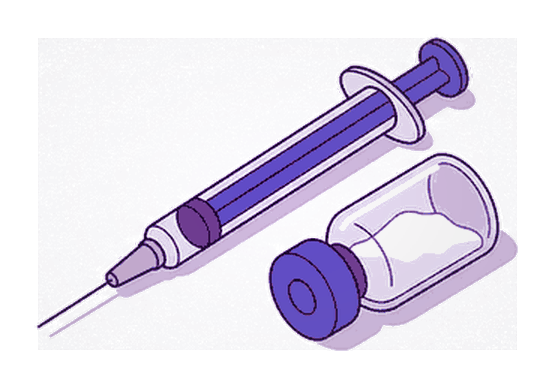
Best reading for small doses: 0.3 mL and 0.5 mL U-100 syringes
A small barrel makes tiny doses clear. Capacity differs: 30 units in a 0.3 mL syringe and 50 units in a 0.5 mL syringe. Both place a line at every 1 unit. Certain 0.3 mL syringes also add 0.5-unit marks, which help with very small draws.
A full 1 mL syringe holds 100 units, yet its barrel is marked only every 2 units. There, 5 units lands in the gap between the 4 and 6 marks, but on a 0.3 mL barrel it has its own line. Learning to read an insulin syringe feels much calmer when you don't have to guess between lines.
Needle gauge and needle length
The box includes needle length in inches along with needle gauge, a measure of how thin the metal is. For common U-100 syringes, gauges are 29, 30 and 31; needle lengths are 5/16 inch, 15/64 inch and 1/2 inch. The higher the gauge number, the thinner the needle. A 31-gauge needle has less thickness than one at 29 gauge.
Healthline's insulin syringe size guide says subcutaneous needles need only reach just under the skin, without going into muscle. That shallow layer is easier to stay in when the needle is shorter. A thinner needle may also feel more comfortable as it goes in.
Don't pair a U-40 syringe with a U-100 calculation
A U-40 scale is common on pet insulin syringes, and 40 units fill 1 mL of liquid on that scale. The 1 mL U-40 syringe pairs a 29-gauge, 1/2-inch needle with 1 unit markings, so its barrel looks similar at a glance. Check the barrel print every time before you draw.
On a U-40 syringe, drawing to 10 units pulls 0.25 mL of liquid, which is 25 units on a U-100 syringe. The liquid you draw is 2.5 times more than the U-100 calculation calls for. Our dose calculator is set up for U-100 syringes.
When is a 1 mL syringe the right choice?
Single draws over 50 units suit a 1 mL U-100 syringe, which holds up to 100 units and is built for that purpose. In 1 draw, a 0.5 mL barrel can't take more than 50 units. When your prescribed amount ranges from 52 to 100 units, the 1 mL size measures the full amount at 1 time.
Frequently asked questions
Is any insulin syringe fine for peptides?
If you use a dosing chart or calculator based on the U-100 standard, your syringe must be marked U-100. Veterinary U-40 syringes are scaled differently, so they measure the wrong volume. If you're unsure what your box says, ask your pharmacist.
Which gauge needle works best for peptides?
There's no 1 single gauge that's best for everyone. For standard U-100 syringes, common gauges are 29, 30 and 31. The higher the number, the thinner the needle, and it may feel gentler against the skin. Which needle size suits your injection site? Your provider can tell you.
Do I need another needle for mixing?
It depends on your medication kit and what your pharmacist gives you. When you mix the vial, the Egrifta SV label on DailyMed specifies a 20-gauge, 1-inch needle. For the injection itself, a 30-gauge, 1/2-inch needle is used. You draw from many other vials with one insulin syringe that has a fixed needle.