
How to read an insulin syringe
Find out what the lines mean on U-100 insulin syringes of 0.3 mL, 0.5 mL and 1 mL, and how units relate to mL and milligrams.
- Syringe size: 0.3 mL
- Units: 30
- Syringe size: 0.5 mL
- Units: 50
- Syringe size: 1 mL
- Units: 100
- on a U-100 syringe, 1 unit
- in mL: 0.01
Your barrel size comes first when learning how to read an insulin syringe, because each small line can mean 0.5, 1 or 2 units. With a U-100 syringe that holds 100 units in 1 mL, match the plunger's top edge with the mark for your dose. For all 3 syringe sizes, you'll learn to count the tick marks and convert units into mL and mg.
Insulin syringe measurements and how to read an insulin syringe
With a standard U-100 barrel, 100 units fit into 1 mL of liquid, so 0.01 mL equals 1 unit. Along the barrel, bold numbers appear every 5 or 10 units, with shorter tick lines between them.
When pulling liquid into the syringe, view the rubber plunger tip head-on through the clear barrel. Place the flat upper edge of the plunger tip, the ring nearest the needle, exactly on your dose line; tap out air bubbles so liquid reaches that mark.
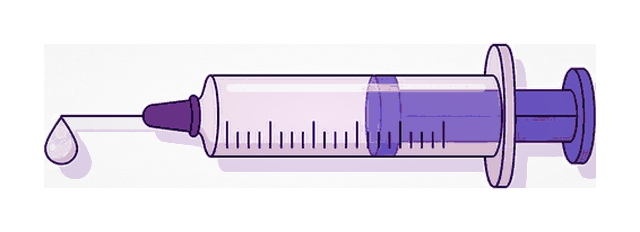
Barrel measurements for 0.3, 0.5 and 1 mL syringes
According to Healthline's insulin syringe size guide, U-100 syringes have 3 barrel sizes; the largest one spaces its lines in a different way. Use our syringe size guide to compare needle length and gauge; a higher gauge number means the needle is thinner.
With a 0.3 mL capacity, this U-100 syringe can hold up to 30 units. Each line shows 1 unit, and some barrels add 0.5-unit marks when smaller doses are needed. Up to 50 units fit in a 0.5 mL U-100 syringe, with each 1 unit marked along the barrel.
Up to 100 units fit in a 1 mL U-100 syringe, where short ticks show 2 units each rather than 1 unit each. For a 1 mL barrel, even numbers such as 24 land on a printed line, while odd numbers such as 25 fall halfway between the 24 and 26 marks.
Converting insulin syringe units into milliliters
Every U-100 syringe holds 1 mL with 100 units. However your vial was mixed, converting units to mL gives the same result. Inside the plastic tube, unit marks measure liquid volume.
Drawing to 10 units to mL gives you 0.1 mL of liquid. A measure of 25 units equals 0.25 mL of liquid, and 50 units equals 0.5 mL of liquid. To work this out, divide the U-100 unit count by 100; that gives you the volume in milliliters.
Converting insulin syringe units to mg depends on the vial you use
The syringe doesn't print the mg amount in each unit, unlike mL, because the strength of your mixed liquid decides it. Before matching units to a dose in mg, you need to know your vial's strength in mg per mL; your prescriber always makes the dose decisions.
When a vial is mixed at 5 mg in each mL, a U-100 syringe measures 0.05 mg, or 50 mcg, for 1 unit; 10 units give 0.5 mg. For a vial mixed at 2.5 mg per mL, 10 units measure 0.25 mg; our units to mg calculator accepts any vial strength.
Confirm the U-100 label on the package
Before opening a syringe wrapper, make sure the barrel is marked U-100. A U-40 syringe is often used for veterinary insulin; it carries 40 units in 1 mL and marks each 1 unit on a 1 mL barrel.
On a U-40 barrel, setting the dose to a U-100 unit number takes 2.5 times as much liquid as the same number on a U-100 barrel; use a U-100 syringe only when your instructions or calculator give U-100 units for the dose.
Questions people often ask
How much is 10 units in mL?
A standard U-100 insulin syringe measures 10 units as 0.1 mL of liquid.
On a 1 mL insulin syringe, what does each line mean?
With a 1 mL U-100 insulin syringe, every small line marks 2 units, which equals 0.02 mL. A 0.3 mL or 0.5 mL U-100 syringe marks 1 unit per small line; some 0.3 mL barrels also include 0.5-unit marks.
What is the reason my syringe says U-100?
The U-100 label means the barrel scale covers 100 units for every 1 mL of liquid. One unit on that scale measures 0.01 mL.