
NAD+ dosage chart
The units to draw on a U-100 insulin syringe for each NAD+ dose, by vial size and the water added.
- vial sizes sold
- 500, 1,000 mg
- approval status
- Not FDA-approved
- in each unit of a U-100 syringe
- 0.01 mL
If you have a 500 mg or 1,000 mg vial, this NAD+ dosage chart shows how milligrams line up with the marks on an insulin syringe. NAD+ isn't approved for use in people, so there's no tested, official dose. The amounts below are round examples to show the math, not doses to take.
- Two vial sizes are sold: one holds 500 mg, the other 1,000 mg
- Syringe: an insulin U-100, with one unit measuring 0.01 mL
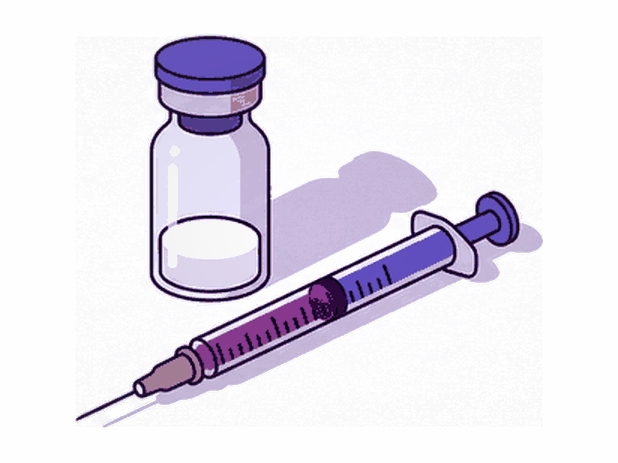
NAD+ dosing chart in units
| Your dose | 500 mg vial + 5 mL | 1,000 mg vial + 10 mL |
|---|---|---|
| 2 mg | 2 units | 2 units |
| 2.5 mg | 2.5 units | 2.5 units |
| 4 mg | 4 units | 4 units |
| 5 mg | 5 units | 5 units |
| 10 mg | 10 units | 10 units |
| 12.5 mg | 12.5 units | 12.5 units |
| 20 mg | 20 units | 20 units |
| 25 mg | 25 units | 25 units |
| 75 mg | 75 units | 75 units |
Dose rows are round amounts for reading the table, not a suggested dose: no FDA label exists.
Approval status of NAD+
It is sold as a research chemical, with no FDA approval for any use in people. Because of this, no official label tells you a dose, a schedule, or a safe daily or weekly amount, which is why injecting it carries real risk.
NAD+ chart in syringe units
The powder has to be mixed with sterile water before you can draw it up. People call that step reconstituting. The usual syringe is the U-100 insulin syringe, which is marked in units, and one unit fills one hundredth of a millilitre.
This chart assumes 5 mL of water in a 500 mg vial, or 10 mL of water in a 1,000 mg vial. Either mix ends up at the same strength, so either vial can use the same row.
Here is what each amount works out to on the U-100 insulin syringe:
| Amount | Units |
|---|---|
| 2 mg | 2 |
| 5 mg | 5 |
| 10 mg | 10 |
| 20 mg | 20 |
| 25 mg | 25 |
| 50 mg | 50 |
| 75 mg | 75 |
| 100 mg | 100 (a full syringe) |
How to read the chart
Begin with the amount of water you put in your vial, because that decides how strong the liquid is. Then find your amount in the Amount column, and the units sit on the same row. Used a different volume of water? Then this chart will not fit your vial, and the strength table shows what shifts.
Strength after adding water
Strength tells you how many milligrams of NAD+ sit in each millilitre of liquid. With less water the liquid is stronger, so you need fewer units for the same dose.
| Vial | Water | Strength | Units for 10 mg |
|---|---|---|---|
| 500 mg | 2 mL | 250 mg in each mL | 4 |
| 500 mg | 5 mL | 100 mg in each mL | 10 |
| 500 mg | 10 mL | 50 mg in each mL | 20 |
| 1,000 mg | 2 mL | 500 mg in each mL | 2 |
| 1,000 mg | 5 mL | 200 mg in each mL | 5 |
| 1,000 mg | 10 mL | 100 mg in each mL | 10 |
Working out the numbers
If you used a different amount of water, the numbers change, so it's worth asking a pharmacist to work them out with you rather than guessing.
If you're unsure, a pharmacist or doctor can check the numbers with you, and that's safer than guessing.
Common questions
Does the chart work for a 1,000 mg vial?
Yes. Add 10 mL of water to a 1,000 mg vial, and it ends up just as strong as a 500 mg vial that has 5 mL of water in it. So 1 unit holds 1 mg, and the whole vial holds 1,000 units.
How does the amount of water change things for a 500 mg vial?
Using 5 mL of water, one unit holds 1 mg, so 20 mg works out to 20 units. With only 2 mL of water the liquid is far stronger, and 20 mg takes only 8 units.